Immigration, Diversity, & “Black” Award Shows

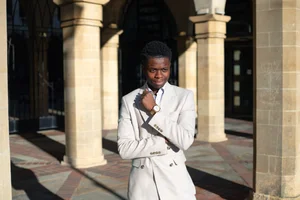
(2025) David stands beneath the cathedral’s vaulted shadow, countenance aglow in the hush of day. Stained-glass colours spill across stone, modern light meeting ancient architecture — a quiet intersection of the sacred and the everyday. This image asks: how do we hold reverence in an age of instant connection? It is a portrait of contemplation and contradiction, where tradition frames the small, persistent acts of contemporary life.
In a fiery clash of perspectives: Samuel Leeds - UK-based property investor, bestselling author, and motivational speaker, faces founder of Gen Z Recruitz, and multi-award-winning entrepreneur - Austin Okolo in the recently released YouTube video titled “My Most Controversial & Heated Debate Yet” on the Samuel Leeds YouTube Channel. Discussing asylum seekers, quotas, and ideas surrounding segregation, they find light contention regarding many talking points in their (slightly over) hour long discussion. Believing that it was an insightful talk, with plenty of available input myself, join me as I unpack key moments, analyse arguments, and present my own perspective on national issues impacting millions across the United Kingdom.
David here, and welcome back to another episode of Controversy Sells. We’ve got tons to talk about (my prediction is that we’ll reach a 30 episode series at minimum), but in order to cover everything in the timeline, I'm aiming for at least at least a release of a new post every week, fair enough? If not, reach out to me on instagram at @keycorporaldavid and let me know what you think.
Immigrants vs Asylum Seekers
“Asylum Seekers are not illegal immigrants, they are lawfully allowed to be in the UK” Austin replied.
This was to Samuel’s rationale for turning down a contract offer in a £3 Million Controversy picked up by the Daily Express, IBTimes UK, and more media/news outlets, placing Samuel’s decisions under scrutiny after he rejected to house asylum seekers at his hotel.
A very pressing political issue in the UK has been about how many people are allowed into the country annually, and for some, how this relates to increasing levels of theft, sexual assault, and many other related examples of criminal activity. For others, it also causes dissatisfaction due to inevitable price increases, crowding of spaces, and other problems.
Austin argues regarding the nuances of the differences between illegal immigrants and asylum seekers, wanting to express the differences in order to convey the legality of asylum seekers’ right for consideration into the UK. Samuel however, argues that many of the asylum seekers in question actually tend to be illegal immigrants.
General Definitions
Asylum Seeker: Arrives in a country and asks for protection because they fear persecution, war, or harm. Their case is being processed, so they are not illegal while they wait for a decision.
Illegal Immigrant: Enters a country without permission (no visa, false documents, or evading border checks), or stays in the country after their visa has expired without applying for asylum or legal status.
Essentially, these two categories are largely dependent on intent AND actions based on that intent, but they are arguably similar in nature and can easily be confused.
“But let’s think about why they’re coming here, right? As you mentioned, they’re fleeing, you know, war, crime, and, you know…for their own safety, right? If you were in their shoes, would you not want to do the same?” Austin continues.
To which Samuel responds:
“I think it’s interesting, because 85% of people that come in are men…and some of them are criminals, and I feel like we have a sense of…protection of our own people in the UK, rather th- ‘Oh you’re coming in unverified, could be a criminal, no record. Yeah, come on in!’ That’s..I feel, a threat to our own people in this country - so I think the system needs re-looking at. However, if someone’s genuinely suffering from war or whatever, then I understand why they’d flee their country. But here’s an interesting question, why don’t they stop at France? Why do they come to the UK?”
This section of the discussion further spirals into speculation regarding the incentive for asylum seekers to head to the UK, the June 2016 public vote, aka “Brexit” (and it’s effect on how the UK deals with asylum seekers), and talk about global conflicts.
Austin: “[…] I also want to come back to this really really quickly, because there’s a few things I want to mention, right? So, when we look at asylum seekers right, and they’re leaving war…the UK is actually at hand for some of these things. The UK is actually funding some of these wars that they [asylum seekers] are trying to flee from as well. So don’t you feel some responsibility, that as a country we need to do something about these people that are fleeing wars that we’ve played a part on?”
Going into this discussion, I believe that the principal understanding a person should have is that it is an exchange of ideas between two well-versed businessmen. Neither individual is a politician, nor do they have any legal certification (relating to law) or achievement according to public record (including academically). However, it’s excellent to have this share of ideas broadcasted from the perspective of a fresh pair of minds. In other words, Samuel is entirely within his prerogative to deny contract deals in any circumstance he chooses as his own business decision, and likewise, Austin is completely within reason to question his intentions and ask for clarification. Samuel believes in a country’s sovereignty and didn't like the idea of “all these faceless, nameless people that have power over our country.”
However, Samuel’s claim behind many asylum seekers being illegal immigrants as they actually arrive in the UK for other reasons (outside of being a genuine asylum seeker) is not found to be proven by any substantial evidence. Data suggests that “the number of asylum applications has been high by historical standards in each of the past three years.” supported by “In 2024, 82,400 applications for asylum were made in the UK […]” all provided by Asylum Statistics - House of Commons Library (Dec, 2025). Objectively, people arriving to the UK on the basis of asylum is at some of the highest seen in the past two decades, but there is no proof that the majority of asylum seekers are “illegal” immigrants, as this would entirely be based on the intent by which they came (either seeking asylum, or - in Samuel’s eyes - just looking for a nice place to stay). However, the point Samuel makes can be argued as true, as if one seeking asylum is no different to an illegal immigrant (principally), in the sense that they have both arrived in the UK with insufficient documentation, then his point carries weight. Samuel’s point can raise further concerns such as “Well, what actually is the process for asylum seekers? What is the insurance or guarantee that the individual is directly affected by war in their country of origin? What metrics are used to assess factors of harm?” and are very excellent questions to ask.
Firing back, further into the conversation, Austin says that consideration should be given to some kind of aid (potentially in the form of the UK being open to asylum seekers) as the UK has participated in the harm of other countries, thus it should be responsible for helping their people. He claims that “They put £7bn towards Yemen. Some of the actual weapons used in these wars (around these countries), are actually British weapons […]” Whether Austin is claiming that arms sales or money itself was provided to Yemen however, is unclear. He also states that the UK’s “colonialism” has caused many problems in Africa, which has sparked many wars as well. There is no data that proves this claim either, but what Austin is likely referring to is arms sales of roughly £7 - 8 billion in weapons to Saudi Arabia from 2015 til the truce in 2022 (Saudi Arabia being one of the main parties involved in the Yemen conflict) according to The civil-society group Campaign Against Arms Trade (CAAT). This was a purchase of UK supplied weapons that were used by Saudi Arabia for military operations inside Yemen. However, Austin is absolutely correct that the UK has been involved in or funding or providing aid or training multiple countries (namely: Iraq, Afghanistan, Libya, Syria, Nigeria, Kenya, etc.) to some extent, but as there isn’t a particular instance cited for his argument, it is weak to argue for the perspective of why the UK should place emphasis on asylum accessibility.
So what are the facts?
The UK signed the 1951 Refugee Convention, which means: If someone reaches the UK and asks for protection, their asylum claim must be assessed. However, the UK does not have to accept everyone (only those who meet the definition of a refugee). In regard to the process of asylum seekers, the Immigration and Asylum Act 1999 sets how persons seeking asylum are processed. And lastly, the belief that it is easier to enter the UK than other countries such as France (as mentioned in the discussion) is (on paper) false. Both France and the UK must consider asylum claims under the 1951 Refugee Convention.
France is part of the EU system which makes it easier access for those already in Europe, but the UK has an independent system (harder to reach, no external application routes).
In the past few years tensions have risen among minds in the UK as many concern about their own safety living in a country once predominantly dominated by people who look like them and speak the same language as them, and others see unfairness in this idea, emphasising the great things people from around the world have added to the UK and the west in general. In my personal opinion, in any circumstance, any country should always prioritise its own people (by citizenship and / or legal residence) before the people of another nation. As a young man growing up alongside The Turkish, Somalians, Nigerians, Pakistanis, Romanians, and many more, I continually saw the beautiful things about never allowing our respective cultures to be a place of division, but rather upholding the integrity of the nation in which we reside. We would all get together and watch the premier league after what felt like a ridiculously long day doing maths in primary school. What made us connected was the funniest moment that happened during P.E (Physical Education), when someone fell over and we kept the banter going for a month with all kinds of silly jokes. Although some cultures around the world deny the idea of citizenship as a birthright, thinking about these past instances make me know for certain that the heart of being British isn’t about the colour of skin, but the culture that was developed in our hearts and minds by the many experiences we shared together, and by our patriotic spirit to have the UK represented well. I think that British people are not wrong for being cautious about someone who doesn’t share the same background (asylum seekers) being allowed on a mass scale into the country. They are trying to preserve their atmosphere, some are skeptical based on the financial climate, and others want to know that they are living in a secure nation. To some degree, the UK might’ve not been the same without legal immigration and asylum, but a question I want to end this section off with is:
“Should the UK open up her legs to the world?” - David
Diversity Quotas & Hiring Practices (Fairness, Representation, and Reality)
“Hitler was not a martyr. Hitler was a psychopath who ended up killing himself.” Samuel Disavows.
Samuel and Austin proceed to discuss the late Charlie Kirk, founder of TPUSA, and a “right-wing” political commentator (who was assassinated on the 10th of September 2025 during a debate event at Utah Valley University - Wikipedia, 2025). Amidst their conversation regarding what a martyr is (mainly how they individually define this term), they discuss talking points that Charlie Kirk had made which (Austin claims) were considered “alarming statements.”
martyr
/ˈmɑːtə/
noun
a person who is killed or made to suffer because of their religious or other beliefs.
"the first Christian martyr"
(Oxford Languages, 2025.)
“So back to Charlie Kirk…right. So, he made some alarming statements about black pilots.” Austin Proceeds.
“No-” *Samuel Chuckles*
“You laugh, but I don’t think it’s funny; what he said.” Austin says.
“[…] I think this is just the danger of people taking ten seconds and basing an opinion on it - you know. I think it goes back to this. But what he said was not racist in the slightest - when you see the context.” Samuel (later) adds.
Austin presents arguably the most “controversial” statement that Charlie Kirk had made online, and uses this to make the point that it could raise the question for whether his assassination really constitutes martyrdom. Austin suggests that a prerequisite to being a martyr is someone that is considered a “good” person, thus he brings the character of Charlie Kirk under scrutiny. Austin claims that Charlie Kirk says: “If I see a black pilot, I will question if he’s qualified.”
“Yes.” Samuel responds.
“That sounds quite racist to me.” Austin affirms.
Samuel talks more about the context of the statements that Charlie made in hopes of making Austin understand where he is coming from.
Austin is making reference to a surfacing clip (at the time) that American journalist, political commentator, and host of The Megyn Kelly Show - Megyn Kelly and Charlie Kirk revisit after the clip’s sensationalism on Twitter. The clip is a reaction to an excerpt of the CEO of United Airlines (Major US Airline), a discussion from June 2021. Scott Kirby (CEO of UA) illustrates the airline’s commitment to making at least 50% of the “classes” women or people of colour (from a figure of 19% of women or people of colour) - Axios (HBO), 2021.
As mentioned, in the stirring clip that went viral, Charlie reacts to this commitment on The Charlie Kirk Show and says:
“No I mean like you wanna go thought crime? Like…I’m sorry, if I see a black pilot, I’m gonna be like ‘boy I hope he’s qualified’.”
This was the moment that surfaced and caused much uproar by people online. A common point in contention that many “right-wing” commentators face is that they are either “racist” or create racist or “harmful” narratives. Thus, after being asked by a debate participant (at another debate event similar to the ones attended by Charlie Kirk) “don’t you think it was an irresponsible statement, to just- [unintelligible] ‘these pilots aren’t qualified’ […].”
Charlie then uses this opportunity to clarify:
“No.”
“But i’ll tell you exactly what I said, and why I said it. I said, if I- *pretext*..I went through a whole wind up. I said if United Airlines is saying that they want 40% of all their pilots to be people of colour or women, we have learned that we have relaxed standards any time that we try to reach racial quotas. Anytime we reach racial quotas, we relax the standards. Standards for air traffic controllers, professors, or college admissions. Therefore when it comes to pilots or surgeons - if I see someone who is black (as I said on the show), i’m going to hope that that person is qualified [...] they’re begging the question we’re not hiring based on merit anymore, we’re hiring based on race. So when you see a black pilot, you wonder is that person there because they earned it? or because they were placed there. That’s what DEI does.”
Back to our discussion:
“Lets just look at it from that regard; of like..we feel more comfortable in our communities […] whether you agree or not, don’t you think our environment plays a role in how well we deliver a job?” Austin maintains his position.
As the discussion with Samuel and Austin continues, Austin argues based on the concept of unity, and uses this to explain that people who are alike or find some resemblance is a determining factor in the achievement of excellence, this is his foundation for suggesting the advantage of using diverse hiring practices.
“You can put a footballer (an amazing footballer) in a team that he does not fit into and he’s gonna be awful […]” he continues.
With more insight about individual experiences from both parties, the exchange only gets more intense; how to dominate fields in spite of racism, mentality & conditioning, and teaching children about race issues.
As we currently speak (Dec, 2025), there is hardly any valid source in the public domain that is descriptive of updates about the commitment that was referred to in the United Airlines clip from 2021. However, it is factually correct that the initiative of pilot diversity in the United Aviate Academy by “aiming for 50 % women and people of colour among its trainees” is ongoing with a goal to train 5,000 new pilots by 2030 - (Capitol Technology University, 2024).
However, to address Austin’s claims from my perspective, I have studied the character of Charlie Kirk very closely, and based on analysis, I would comment that he was a Christian martyr of our generation. Charlie Kirk was a widely misunderstood character who strived to live in an America that didn’t see colour as much as it currently does, and a world that also shares this position. Additionally, many “right-wing” commentators are considered Nazi: members of the National Socialist German Workers’ Party (the political party led by Adolf Hitler that ruled Germany from 1933 to 1945) because of their viewpoints of tradition and nationalism that may present to the left-wing as radical or extremist. It is objective that Charlie Kirk and Hitler were different in close-to-every way under the sun. Charlie Kirk wanted to uphold the nation he lived in by building on the platforms of the people who originally laboured for the country, whereas Hitler engaged a glorification of violence, facism, and absolute control. Charlie loved people, regularly giving many people of every skin colour, background, gender, and culture (who otherwise wouldn’t have the chance) an opportunity and platform to debate him on topics that pertained to America’s future. Hitler (in his approach) was intolerant of opposition, using a main method of totalitarian dictatorship to enforce ideologies, and massacring people who were not considered of a specific racial category altogether. Alongside this, Charlie Kirk was studied in regard to the bible - regularly using scripture and quoting bible verses as he spoke. His faith was openly strong, even to the point of promoting ancient Jewish customs (the Sabbath for example).
Unfortunately, many people (who were previously impartial) never get to see full videos in 2 hour formats, which is what I believe Austin falls victim to in this case. Misunderstanding typically happens by:
Emotional triggers overriding logic: Narratives built around fear, outrage, or hope bypass critical thinking.
Repetition creating perceived truth: When a narrative is repeated across platforms, people begin to accept it as fact simply because it feels familiar.
Social pressure and identity attachment: Once a narrative is tied to a group identity, people may adopt it to fit in or avoid conflict, even if it exploits their trust or goes against their own interests.
Moreover, there is agreement between Austin and Samuel regarding environments and how they may be a factor towards success (in regard to advantages of diverse hiring). However, I would like to make clear - the difference between roles and positions in society that are largely dependent on team-work versus those that do not need as much coordination with groups / general interaction. To substantiate Austin’s earlier football claim with data:
“The results of the study proved the existence of four cohesion and efficacy profiles that presented significant differences in expectations of success, playing time, and performance. Furthermore, significant differences were found in the distribution of players in the teams as a function of performance. The main conclusion of this study is that soccer players with higher cohesion and collective efficacy levels belonged to teams that completed the season at the top-level classification. In contrast, athletes with low cohesion and collective efficacy usually played in unsuccessful teams.” (PubMed - García-Calvo et al., 2014).
Chemistry is surely a great benefit in any team, and is essential for any thriving organisation. However, Samuel’s argument (based on Charlie Kirk’s original messaging) is that when circumstances outside of qualification and pure “merit” (such as trying to build interpersonal links between employees - the essence behind Austin’s argument) are prioritised over performance, the best of the best are no longer being selected for a role. Without being too technical, performance (in general) is largely relative, and often times, an employer (looking to hire the best talent to build their organisation) will prefer the most suited candidate for a position which is likely to be based on key competencies / work experience / professional qualifications / academic achievements, and factors of achievement - which will be compared with other applicants. In order to mitigate misinformation, it’s also necessary to acknowledge that although diversity goals within any organisation is not inherently illegal (as in the case of United Airlines), employment racial quotas are explicitly prohibited - (Title VII of the Civil Rights Act, 1964). However, companies can still use the mentioned “targets” or “goals” in order to publicly declare their intentions for hiring.
excellence
/ˈɛksəl(ə)n(t)s/
noun
the quality of being outstanding or extremely good.
"awards for excellence"
(Oxford Languages, 2025.)
…is a grail materialised by every notable person regardless of their field, and I would use as the only encouragement to a young person black or white in the pursuit of their dreams. Furthermore, I conclude this section with some few pieces that I noted down. The interviewer of Scott Kirby: Dan Primack, business editor at Axios - made a passing comment in the clip of Scott Kirby’s announcement of the United Airlines’ diversity hiring commitment. He says “White males don’t just dominate in the cockpits, also in the c-suite at United Airlines.” Frankly, I’m always disappointed to see the partiality and overt unfairness fired at people that are not considered “ethnic minorities.” I can only imagine this same statement made about black people in a predominantly black field - it devalues the effort of genuine working-class people entirely, and presents to public opinion that race and the pigment of one’s own skin is their destiny. No one likes being discredited for any work that they do simply because people say they had a “leg-up” in anything: a videogame competition, sports tournament, or virtually anything that is player versus player. Megyn Kelly communicates it best...
Megyn Kelly:
“And the proper response was (from you [Charlie Kirk], from people like Matt Walsh) ‘This is the world you people have created. You have created this world where you make somebody’s skin colour the sole criterion for hiring, and then you react in horror when people wonder whether the qualifications are actually there’.”
(concisely) “Black” Award Shows - Empowerment or Segregation?
I’m not saying that it shouldn’t be allowed..i’m just saying- I just said that I think it’s a bit dumb” Samuel says.
“But why do you need to have an opinion on it though?” Austin replies.
“You asked me what my opinion was!” Samuel guffaws.
In one of the rearmost, yet heated, topics of the talk, Austin (hearing Samuel’s position regarding previous talking points) dwells on race-oriented questions, mentioning “black award shows” which Samuel gives candid responses to.
For those who don’t know however:
Award Show
“A production, usually televised, in which awards are presented to winners, usually featuring additional forms of entertainment, such as musical performances.” (IGI Global, 2025)
The idea of race-categorisation has been popularised in the past few years, but has also picked up much controversy on the internet too.
Samuel: “A black business awards show. It’s almost like you can’t get an award (a proper one) ‘but don’t worry, we’ll do a black version.’ What?”
For reference, the National Association for the Advancement of Coloured People hosts award shows, a chief example of Austin’s point.
“The NAACP Image awards has been widely accepted and dubbed as the "Black Oscars/Emmy/Grammy" award show from the African-American and Latino community, as it is an important prestigious award celebrating artists and entertainers of colour that may have been overlooked from by the mainstream film, television, theatre and music award counterparts (E.G.O.T.) due to racial seclusion or lack of interests from film and television studios.” (Wikipedia, 2025)
The racially charged subject can be a large space to explore, but can also be met with much contention. Essentially, the disputes about the topic always argue one of two sides: whether “black spaces” are celebratory, or divisive. The NAACP’s own target for award shows support Austin’s claim for the motivation behind such events. From the perspective of individuals that agree with the vision, and organisations that host these events, award shows are illustrated as “representative” and give platforms to key figures in spaces that might’ve not been recognised had they not been given a category of their own.
Samuel: “But you said you love Martin Luther King. His vision was- he said ‘Little black boys, little white boys. Together.’ He was anti-segregation, so I think combatting racism is being anti-segregation. And these things like ‘black award shows’ I don’t have a massive problem with them- I think they’re a bit dumb, and I also think they’re a bit segregating as well, it’s like ‘let’s bring our own together’ that’s how I see it.”
My take:
To me, there is an upcoming wave of unrealistic people that are setting western societies backwards, and not helping their continued advancement at all, and while I do not advocate for any type of online censorship, I believe that a person’s convictions should always be up for testing (especially by others), and the opportunity for someone to be wrong should always remain a possibility.
Explaining this, many forms of segregation were intentionally abolished in western nations for key reasons of continued racism and in the worst instances, radicalisation, but I think that the strive for categorisation doesn’t “highlight” or promote “excellence” it only creates more barriers. Leagues that say “black” and “everyone else” is a pure form of racism in my eyes, and the double standard doesn’t reverse many years of hurt already made. I think that history should always be considered, but I would completely disagree that any country in western society is still having an issue of race-oppression as it was a few generations ago.
Looking from Austin’s perspective, I understand how promoting unrecognised talent might encourage the undiscovered, and drive others to great works by extension, but I would also argue that it is not solely young black people that are unrecognised. There are tons in the categories: asian, hispanic, arab, and more that always go unrecognised, and I believe that it is perhaps less of an issue to do with race, but more about consistency and years accrued on the record.
Pertaining to both Samuel and Austin, I do want to clarify that it is clear that neither has intentions of harmful ideologies, and as mentioned before, they are both allowed to think strongly about certain matters. Samuel believes that black award shows are unnecessary and excellence can be achieved regardless of special event (but does not forbid or condemn them), and Austin thinks that they are a vital part of showcasing the skill and wins in the black community.
And, in a very quick section (by video length) that brings this final topic to a close.
Editor’s Final Word
Samuel and Austin’s debate was varied, and ultimately, the purpose of these exchanges should always be to examine opposing viewpoints, clarify ideas, and challenge assumptions. It helps participants and audiences think critically about an issue.
I hope this read proved to be eye-opening. Discuss it with someone, go ahead and watch the YouTube video of the debate and talk it through with someone.
Thanks for reading, I hope it enlightened you and sparked some insight.
See you next time.
Warmly,
- David
Controversy Sells